Showing posts with label Fact. Show all posts
03/05/2013
Clapping music
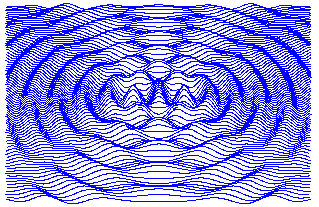
In this piece, Reich uses the most fundamental of human attributions, beside the voice, to "create a piece of music that needed no instruments beyond the human body". This piece of work, while developed from an intrinsic knowledge of music, is also based on rules, and therefore, patterns. I was struck when revisiting this piece recently, that one could liken this piece to wave interference patterns; those moments where the patterns of the rhythm fall in and out of sequence with each other constructive and destructively, adding to the rhythm, creating moments of quiet.
"...one performer claps a basic rhythm, a variation of the fundamental African bell pattern in 12/8 time, for the entirety of the piece. The other claps the same pattern, but after every 8 or 12 bars s/he shifts by one eighth note to the right. The two performers continue this until the second performer has shifted 12 eighth notes and is hence playing the pattern in unison with the first performer again (as at the beginning), some 144 bars later."
See also: A juggling interpretation and György Ligeti's Poème Symphonique For 100 Metronomes.
– Rosie
Labels:
Fact,
Invisible Structures,
Lecture One,
sound,
Wave-particle duality
The famous couple
“It was very hard finding this photograph. We needed to navigate the thin channel between full bodily disclosure and NASA’s fear of the adverse publicity generated by sending pictures of naked people into space. Apparently we failed, because this was the only picture in our final image sequence that NASA would not allow on the Record.
I had the idea of drawing silhouettes to accompany selected Voyager photographs in an attempt to help the ETs understand how we see pictures, and the importance of edge-detection in our vision. By maximizing the figure/ground relationship of the important subjects, I hoped the photographs would be easier to understand.
This photograph of a nude human couple was taken by George Hester, a widely respected photographer of nudes. His photograph did not fly but the silhouette did. How mysterious it may seem to ET looking for the photograph that should accompany this silhouette. How will they explain the absence? Is the concept of body taboo even possible for ET to infer?
NASA was less concerned about offending ET’s sensibilities than the reaction of the contemporary audience. They decided that the American public was not ready for full frontal nudity on spacecraft. They worried the public would react negatively and the result would be an unfavorable reaction that would damage NASA.
In almost thirty years of telling this story to audiences of every demographic makeup, I have yet to find a single person who admits to agreeing with NASA’s decision. In fact it has been considered the worst error made in the creation of the Voyager Record.”
– An account by Jon Lomberg

Labels:
Fact,
Human,
Invisible Structures,
Scientific Method
Pioneer plaques
![]() |
Designed by Carl Sagan & Frank Drake; artwork by Linda Salzman Sagan.
|
“The Pioneer plaques (9x6 inches) are a pair of anodized aluminum plaques which were placed on board the 1972 Pioneer 10 and 1973 Pioneer 11 spacecraft, featuring a pictorial message, in case either Pioneer 10 or 11 is intercepted by extraterrestrial life. The plaques show the nude figures of a human male and female along with several symbols that are designed to provide information about the origin of the spacecraft.
...The Pioneer spacecraft were the first human-built objects to leave the Solar System.”
The plaque contains within its pictorial symbolism a complex message which assumes a language or method of reading that on the one hand details a scientific methodology for deducing the spacecraft’s origin, and on the other attempts to convey something elementary about the life-form that is the cause of its existence. It is at once minutely specific and also metaphorical; on the left hand side, it details a radial pattern which stand for “periods of pulsars, using the hydrogen spin-flip transition frequency as the unit” and on the right, the naked white Occidental man raises his hand in good will. We have paired ourselves down to our most simplified and elementary components as a way of revealing something essential about humankind, but what are we really conveying about ourselves?
See also: Edward Tufte's redesign of the plaque, the voyager golden record and the Arecibo message.
– Rosie
Labels:
Fact,
Human,
Invisible Structures,
Scientific Method
02/05/2013
Resources from Lecture 3: Electricity
Educational films explaining the physical principles behind sound waves, their generation and manipulation:
The Nature of Sound (1948)
Sound Waves and Their Sources (1933)
An overview of concepts in electricity, covering topics such as electric charge, current and conductivity, electric and magnetic force:
Principles of electricity (1945)
An educational film showing the creation of magnetic fields through electrical current:
Electromagnets (1966)
An educational film covering phenomena such as reflection and refraction of light, focussing and the principles of cameras:
The Nature of Light (1948)
A historical overview of color and the associated physical principles of light. The film is split in six parts:
Light and Color
A public lecture by Richard Feynman explaining the wave-particle duality and its role in quantum mechanics:
Richard Feynman: Probability and Uncertainty – The Quantum Mechanical View of Nature (1964)
Labels:
Electricity,
Fact,
Invisible Structures,
Lecture Three,
Light,
sound,
Wave-particle duality
01/05/2013
Using light to talk about light
![]() |
| Bill Culbert - An Explanation of Light (1984) |
Ask yourself: what does this piece explain (if anything) about the physical nature of light? Furthermore, what can art do to the function and meaning of an object?
Art behaves and explores topics very differently than science. Artists can be as ambiguous as they like (if they like), they invite open interpretation in an individual’s theoretical framework, as well as without a framework. Art is free to be totally ambiguous and misleading, it can mean whatever the viewer thinks or wants it to mean as well as what the artist intended it to mean at the same time. Is falsifiability impossible in establishing meaning in art? Is there a spectrum of this impossibility (if any at all) if we include illustration and information design?
As for science, although experiments, theoretical reasoning and discourse can yield very ambiguous and strange results, the way scientists invite interpretation is concerned with inviting contestation and matching an interpretation against a distinct, descriptive, theoretical framework based on mathematics, logic, empiricism and falsibiablility.
Where and how can art and science overlap? How (if at all) do they both attempt to repudiate the notion of universal facts and truths? Both art and science are concerned with critical enquiry i.e. re-think this light bulb as a functional object , re-think its properties or re-think the physical nature of light. How do both art and science contest epistemological justification, representationalism, and the notion of epistemic objectivity?
– Jennifer
Labels:
Fact,
Invisible Structures,
Light,
Scientific Method
The face on mars
![]() |
| The original image taken by the Viking 1 orbiter in 1976. |
Humans have always projected their own hopes and fears onto interstaller objects like this famous cultural anthropomorphism. As a social species we are particularly hard-wired to recognise faces. Perhaps this is the reason why Jesus pops up on a piece of toast, or a giant face emerges out from the shadows of arbitrarily arranged Mars rocks.
![]() |
ESA/DLR/FU Berlin (G. Neukum), MOC (Malin Space Science Systems)(2006)
|
NASA used the likeness to their advantage, as a way to garner interest in Mars. They even suggested themselves in the 1976 press release: "The picture shows eroded mesa-like landforms. The huge rock formation in the center, which resembles a human head, is formed by shadows giving the illusion of eyes, nose and mouth." When NASA returned to Mars in 1997, they felt they owed it to the taxpayer and reshot this famous image. With better quality equipment, the mystery disappears. No human head, no alien monument. Just a natural landform.
Read more about unmasking the face on Mars.
– Natalie
Labels:
Anthropomorphism,
Fact,
Invisible Structures,
Lecture One
30/04/2013
Making sand swim
![]() |
| Klaus Weber Sand Fountain (2012) |
Klaus Weber's piece Sand Fountain is both transformative and oppositional – encouraging a reconsideration (among other things) of what a fluid is, even if water is wet and sand is dry – if one can be substituted by the other then what exactly is the difference?
The falsification criteria that Malte spoke about is also concerned with being oppositional, exploring where our theories and ideas about the world break down and where they hold their own.
– Jennifer
Labels:
Fact,
Invisible Structures,
Lecture One
29/04/2013
Sun, Planet, Moon
The PhET project at the University of Colorado have a huge range of interactive simulations which help to visualise some difficult concepts. Above is a screen shot of 'My Solar System' describing orbits and gravitational pull of massive bodies; of the Moon around the Earth and the Earth and Moon around the Sun.
Labels:
Fact,
Gravity,
Invisible Structures,
Lecture Two,
Motion
Science fiction: Asking questions to the future
Latest since the industrial revolution, the cultural significance of science has become impossible to miss. It has transformed our lives beyond recognition and is continuing to do so at an ever increasing speed. The technologies we create change the way we interact with the world. Through the internet we have created means of communication that are dissolving our traditional notions of time and information. Before we have even come close to understanding its significance for the coming generation, this piece of technology itself has already transformed again and is now delocalised and touchable on a smart phone. How will this development change our view of the world? Will we be able to keep up with our own progress? Through science and technology, we have not only achieved a greater understanding of the world around us, we have also become able to shape it. But what happens when we do it?
Science fiction often attempts to trace out the answers without us even asking. Which way will tomorrow’s technology pave for us? What role will it play in the future of our society? As complex and speculative as these questions are, we cannot hide from them. In many science fiction stories this becomes most strikingly obvious when artificial intelligence enters the stage. We may be able to avoid asking ourselves the question what we want to do with our technology. But should we ever build an intelligent machine, it will do it for us. From ‘Odyssey 2001’ to ‘Blade Runner’ and Isaac Asimov’s short stories, once the future itself asks us how we got there, we better come up with a good answer.
– Malte
Signs of the Fourth Dimension
In this lecture author and professor at the University of Texas, Dr. Linda Dalrymple Henderson, discusses the subject of her book 'The Fourth Dimension and Non-Euclidian Geometry', pictured below. In it, she traces a parallel development between developments in geometry and modern art.
Non-euclidian geometry required a shift in how we perceive and understand the space we live in, from assumptions based on immediate perception and human experience to concepts which are no longer derived from human experience and intuition. You can draw two parallel lines on a piece of paper and they will never meet, but draw those two lines across the surface of the spherical Earth and they will curve and meet. Henderson argues that this development, with the possibility of a spatial fourth dimension "encouraged radical innovation by a variety of early twentieth-century artists, ranging from French Cubists, Italian Futurists, and Marcel Duchamp, to Max Weber, Kazimir Malevich, and the artists of De Stijl and Surrealism."
More on Non-Euclidean Geometry:
Labels:
Fact,
Geometry,
Invisible Structures,
Lecture One
26/04/2013
Whipple, Wave Machine
A late C19th model to demonstrate how waves move; made by the Elliott Brothers, to a design by Baden Powell ((1796-1860) – the father of Robert, founder of the scout movement). An interactive animation here.
This — and other explanatory scientific models — can be seen at the seemingly wonderful University of Cambridge Whipple Collection. Here — with a linking thought on the 'sculpting' or 'choreography' of sound waves — an unattributed pair of parabolic sound mirrors, again late C19th.
The principles apply through a history of use, from these almost Neolithic, pre-radar wartime sound mirrors (via Web Urbanist) to today's satellite dishes.
Some lovely examples collected by Web Urbanist, for example this Czech 'acoustic detector', c. 1920.
Labels:
Fact,
Instruments,
Invisible Structures,
Models,
Waves
17/04/2013
Invisible Structures
![]() | |
"Visualization is not simply a mediation between an independent world and a human perceiver. An image does not stand between the thing itself and a knowing subject. The selection of specimen, sites, the re-ordering of fields into grids, the operations of tagging, encoding, and marking, these activities reach into the world, arrange it in a pose, and cultivate its accountability. These artifices do not necessarily negate the world's natural accountability, although in some cases they are blamed for distortions and illusions. Instead, they are the very means through which natural order is revealed, ordered, compared, encoded, and quantified. Consequently, in answer to the question of what studies of visualization are about, we can say that they are about the production of scientific reality."
Michael Lynch, "Visual Cultures of Science" (2006)
– Malte
Labels:
Fact,
Invisible Structures,
Lecture One,
Scientific Method
Jiggling Atoms
Every project we do seems to start with Richard Feynman, and this series, called Fun to Imagine, is where we also derived our name. Feynman was not just a wonderful teacher, but was also a tremendously gifted theoretical physicist; he worked on the atomic bomb, got the Nobel prize in 1965 and also played the bongos (amongst other things). But of course, most importantly for us, it's his incredible gift for explaining physics to non-scientists. All from the seat of his armchair, watch how he reveals with such wonderful poetry and insight about "the unbelievable nature of nature".
Labels:
Fact,
Invisible Structures,
Lecture One
03/01/2012
David Hockney's Bigger Picture
David Hockney interview from Royal Academy of Arts on Vimeo.
David Hockney's major new exibition opens at the Royal Academy on January 21st. He is an artist who works within the Renaissance tradition of depiction, with those central concerns of nature, space and time, and, as in this forthcoming show, the tradition of the landscape. But he is also an artist who has embraced new technology; photography, fax, and now the iPad. I have always admired him - his draftsmanship, his thoughtfulness, and even his humour.
Last week (26 Dec 2011) BBC Radio 4 devoted a Start the Week programme to Hockney, discussing his latest work. The in-depth interview by Andrew Marr was both revealing and fascinating. He spoke about drawing, about observation of nature, the benefit and the excitement of seeing consecutive springtimes at the same place over a number of years. It showed the depth of his engagement with his subject.
He had a lot to say about technology, and it is apparent that the use of computer technology has become integrated into his process of picture making, even when the result is painting. David Hockney has always been interested in technology, not for its own sake, but in furthering his picture making.
The camera is one example of his embracing of technology and investigation of picture making. 'Photography is not a final reaching of reality. Technology is opening something up, we are able to alter pictures.' He also noted that 'Cameras give you a certain type of view, but it’s not the human view.'
![]() |
| David Hockney (1983). Walking In The Zen Garden, Ryoanji Temple, Kyoto
1983 photographic collage, 40 x 62 1/2 in. http://www.hockneypictures.com/photos/photos_collages_06.php |
![]() |
David Hockney (2011) The arrival of spring in Woldgate, East Yorkshire in 2011
ipad drawing printed on paper 144.4 x 108.3 cm © David Hockney http://wwwimg.bbc.co.uk/programmes/i/512xn/f11b28a2e586a3017ad932e490ddc80eb46f1fc5.jpg |
For me Hockney's approach encapsulates the paradoxical relationship with the world which we can now enjoy (and I do mean enjoy) - he embraces the latest technology whilst, at the same time, acknowledging the importance of craft and of 'the hand'. He cited a Chinese saying: 'In drawing you need the hand, the eye and the heart. Two won’t do!'. And he spoke about the importance of craft in the work of the artist. 'I would say the hand counts, there’s a whole group of other people who say it doesn’t, it’s a little bit insulting to craftsmen isn’t it?' And this aspect of craft has an importance for pedagogy, he maintained:
Food for thought... perhaps, to some extent, one can teach, or at least encourage and facilitate, the poetry (not forgetting of course that there is also a 'craft' to poetry). But Hockney poses here the interesting question of just where that balance lies between the poetry and the craft in the teaching of art.'I used to point out, in an art school, you can teach the craft. It’s the poetry you can’t teach, but now they try and teach the poetry and forget the craft. It’s craft that can be taught.'
He related a story about his Mother coming to his exhibition at which there was a sculptural piece by Barry Flannagan whichcontained a large rope. 'Did he make the rope?' his Mother asked...
Bibliography
Start the week: David Hockney Special (2011). BBC Radio 4. Monday 26 December. 45 minutes. Available at http://www.bbc.co.uk/programmes/b018g2yz (Accessed 4 Jan 2012)
Royal Academy of Arts (2011). David Hockney RA: a bigger picture. Interview. Royal Academy of Arts Video online. http://www.royalacademy.org.uk/exhibitions/hockney/ (Accessed 4 Jan 2012)
Links & information
- You can listen to the BBC interview with David Hockney at http://www.bbc.co.uk/programmes/b018g2yz
- David Hockney RA: A Bigger Picture can be seen at the Royal Academy from 21 January to 9 April 2012. Advance booking is recommended. http://www.royalacademy.org.uk/exhibitions/hockney/
- http://www.hockneypictures.com/home.php
- See also Peter Nencini's reflections on the handmade and the digital in this earlier post on Camberwell Illustration
Wroe, N (2012) David Hockney: a life in art. The Guardian (Review), Jan 14, <Available online at> http://www.guardian.co.uk/culture/2012/jan/13/david-hockney-life-in-art (Accessed 14 Jan 2012)
'The iPad is like an endless piece of
paper that perfectly fitted the feeling I had that painting should be big'says Hockney in this Guardian interview.
Labels:
David Hockney,
Drawing,
Exhibition,
Fact,
Landscape,
Painting,
Photography,
Royal Academy
20/11/2009
the Glacier Project


Series of books by Elizabeth Jackson that explore and explain the nature of glaciers through the books' physical qualities. Click here for more information
12/11/2008
Slimy Drawings

Architect partnership Ushida Findlay's 'Slimy Drawings' for Soft and Hairy House (Ibaraki, Japan 1994) and Truss Wall House (Tokyo, Japan 1993).

The houses carry a signature, organic configuration of space where inside becomes outside and vice-versa. Therefore conventional plans and elevations won't do, as expressions of the house-to-come. So they developed 'slimy drawings' in order to see everything at once. Somehow this is more poetic than a CGI flythrough; although that might be my limitation.
Labels:
Fact
Ernst Haeckel

Bats, from Ernst Haeckel's seminal Kunstformen der Natur (1904). Adrian will discuss Haeckel in lecture 3 of his Art & Science series. Haeckel, a zoologist-artist (that doesn't quite cover his achievements), popularised Darwin in Germany (On the Origin of Species was published in 1859).

Haeckel's system of imaging and composition is of a laid-bareness, a head-on symmetry that emphasizes recurring geometries across species and nature. This supports his "recapitulation theory ('ontogeny recapitulates phylogeny') claiming that an individual organism's biological development, or ontogeny, parallels and summarizes its species' entire evolutionary development, or phylogeny." (Wiki).

He sometimes resorts to a more illusionistic, three-dimensional space but it is quite rare through the 100 or so plates. It happens through his motive to articulate and reveal. This is perhaps unfamiliar to you and a step you are required to take in the project. That is, composition, formal decisions borne out of a need to explain.
Labels:
Fact
11/11/2008
10/11/2008
Kyushu University Medical Books
Eye discolouration (as seen on the amazing BibliOdyssey) by Majimaganryonozu, from a collection of C18th and C19th Japanese medical books archived online by Kyushu University.
Dermatological conditions by Hosonozu. See more here and note the intertwined image, calligraphic text and the use of flatness and abstraction for organ-forms.
Labels:
Fact
Subscribe to:
Posts (Atom)