
19/05/2011

04/04/2011
Roland Barthes' Camera Lucida - The Guardian March 26 2011

Roland Barthes. Image http://faculty-staff.ou.edu/L/A-Robert.R.Lauer-1/roland-barthes.jpg
Somehow I missed this piece by Brian Dillon (Guardian March 26 2011) when it was published last week. But Re-reading Camera Lucida by Roland Barthes does serve as a welcome (and poignant) introduction to a work that is not only a wonderful book on photography, but a wonderful book, full stop.
Dillon makes the interesting point that Barthes' subjective approach is academically contentious:
It's this (in academic terms quite scandalous) embrace of the subjective which allows Barthes to begin the quest that makes his book so moving. Having lost his mother, with whom he had lived most of his life, he goes looking for her among old photographs... (Dillon 2011)
In this little book Barthes achieves the feat of marrying academic discourse to the personal. Perhaps it is 'scandalous' as Dillon suggests, but the subjectivity in Barthes' writing is what makes it not just wonderful critical writing on photography, but also great literature.
Do read it...
Bibliography:
Barthes, R. (2000) Camera Lucida: reflections on photography. London: Vintage
Dillon, B. (2011). Re-reading Camera Lucida by Roland Barthes. In: The Guardian, March 26. [Online] Available at http://www.guardian.co.uk/books/2011/mar/26/roland-barthes-camera-lucida-rereading [Accessed April 4, 2011]
23/03/2011
London and the Multisensory City

William Hogarth (1741). The enraged musician. Engraving. Image source: http://www.tate.org.uk/britain/exhibitions/hogarth/images/works/the_enraged_musician.jpg
Hogarth's friend Henry Fielding, said that the Enraged musician (1741) was 'enough to make a man deaf to look at it' (Uglow 2008:55).
We visited the idea of the multisensory city, which Hogarth manages to express visually, in an earlier post on this blog. For more on this, see the latest issue of TENGEN magazine where I have an article London, the multi-sensory city expanding on some of the ideas in that post. My colleague Gareth Polmeer has an accompanying piece, The cinematic map, reviewing the new film on London by William Raban, About now: MMX (2010).
Bibliography
About now: MMX (2010). Directed by William Raban. Film
Holme, A. (2011). London, the multi-sensory city. Tengen Magazine. No. 3, (March), Pp.3-5 http://issuu.com/tengenmag/docs/tengen_issue_3 (Accessed March 23, 2011)
Polmeer, G. (2011). The cinematic map. Tengen Magazine. No. 3, (March), Pp.5-6 http://issuu.com/tengenmag/docs/tengen_issue_3 (Accessed March 23, 2011)
Uglow, J. (2008). Words and pictures: writers, artists and a peculiarly British tradition. London: Faber and Faber
We visited the idea of the multisensory city, which Hogarth manages to express visually, in an earlier post on this blog. For more on this, see the latest issue of TENGEN magazine where I have an article London, the multi-sensory city expanding on some of the ideas in that post. My colleague Gareth Polmeer has an accompanying piece, The cinematic map, reviewing the new film on London by William Raban, About now: MMX (2010).
Bibliography
About now: MMX (2010). Directed by William Raban. Film
Holme, A. (2011). London, the multi-sensory city. Tengen Magazine. No. 3, (March), Pp.3-5 http://issuu.com/tengenmag/docs/tengen_issue_3 (Accessed March 23, 2011)
Polmeer, G. (2011). The cinematic map. Tengen Magazine. No. 3, (March), Pp.5-6 http://issuu.com/tengenmag/docs/tengen_issue_3 (Accessed March 23, 2011)
Uglow, J. (2008). Words and pictures: writers, artists and a peculiarly British tradition. London: Faber and Faber
17/03/2011
Shopping: JG Ballard - Kingdom Come

JG Ballard's last novel, Kingdom Come (2007), is centered on a shopping mall.
Note the reversal and interchangability of agency between the consumer and the commodities in the 'Metro-Centre' in this excerpt from Ballard's writing which is to be found towards the finale of the novel:
Vaguely searching for a more comfortable matress than my fever-sodden berth
in the hotel, I stood in the entrance to the store as the pilot lights shone on
the freshly waxed floor. A work party had moved through the ground level, and
the tang of polish hung on the unmoving air, making me feel almost giddy. By
sweeping out these temples to consumerism, by wiping and waxing and buffing, we
made clear that we were ready to serve these unconsecrated altars. Every shop
and store in the Metro-Centre was a house of totems. We accepted the discipline
that these appliances and bathroom fittings imposed. We wanted to be like these
consumer durables, and they in turn wanted us to emulate them. In many ways, we
wanted to be them...
(Ballard 2007, p235)
Ballard's writing brings to mind Marx's idea of the commodity fetish (1990, p163), and also Guy Debord's Society of the spectacle:
67. The satisfaction that no longer comes from using the commodities produced in abundance is now sought through recognition of
their value as commodities. Consumers are filled with religious fervour
for the sovereign freedom of commodities whose use has become an end in itself.
(Debord, p33)
Guy Debord refused to copyright his work. The complete text (in translation) is available here http://www.bopsecrets.org/SI/debord/index.htm
Debord's film, The society of the spectacle is available here http://www.ubu.com/film/debord_spectacle.html
BibliographyBallard, J.G. (2007). Kingdom Come. London: Harper Perennial
Debord, G. (No date given). Society of the spectacle. Rebel Press
Marx, K. (1990) Capital. Volume 1. London: Penguin Classics
16/03/2011
Shops on Screen
They Live (1988), directed by John Carpenter.
The Stepford Wives (1975), directed by Bryan Forbes.
The Pawnbroker (1965), directed by Sidney Lumet.
Gun Shop (1977), with Richard Pryor.
Local Shop from The League of Gentlemen (1999–2002), with Reece Shearsmith, Steve Pemberton.
Four Candles (1976), with The Two Ronnies.
06/03/2011
Watercolour, Tate Britain

Edward Lear, Macropus parryi, watercolour, reproduced as a lithograph in Volume 1 of the Transactions of the Zoological Society of London. Image source: http://static.zsl.org/images/width500/img-2054-600-9107.jpg
One does not necessarily think of the poet Edward Lear as a zoological illustrator. But his watercolour of the Kangaroo was just one of the surprises that awaited me at the Watercolour exhibition at the Tate Britain (until August 21, 2011).
It is an excellent show bringing together often less well known watercolour works by major, and sometimes less well known artists - Turner, Blake, Samuel Palmer, Graham Sutherland, alongside Cozens, Paul Sandby, Wenceslas Hollar.
The thematic curation can be a little irritating - you arrive at a bit of a hotch potch of works in places, and at times it seems overly didactic. Some of the categories do in fact work - The Natural World, and Travel and Topography being good examples, but other categories are much more open and less convincing than a chronological approach - Intimate Knowledge, Abstraction and Improvisation, InnerVision - and here we are at the whim of the curator (hence the dispersed Turners, some breathtaking late works in Abstraction... of course we know what the curator means, but the subtlety and the differences get lost beneath such heavy handed didacticism.)
Some of the time I found myself marvelling at technique (how does Turner in his landscapes, achieve such an apparent freedom and overall unification of the image together with such exquisite fine detail?) and at many works that did not, even on close inspection, seem to resemble watercolours, such were their technical strengths.
All in all, this is a show that must be seen - and, I would have thought, a particular delight to any illustrator. It has really made me rethink the possibilities and the vast potential of the medium.
It is an excellent show bringing together often less well known watercolour works by major, and sometimes less well known artists - Turner, Blake, Samuel Palmer, Graham Sutherland, alongside Cozens, Paul Sandby, Wenceslas Hollar.
The thematic curation can be a little irritating - you arrive at a bit of a hotch potch of works in places, and at times it seems overly didactic. Some of the categories do in fact work - The Natural World, and Travel and Topography being good examples, but other categories are much more open and less convincing than a chronological approach - Intimate Knowledge, Abstraction and Improvisation, InnerVision - and here we are at the whim of the curator (hence the dispersed Turners, some breathtaking late works in Abstraction... of course we know what the curator means, but the subtlety and the differences get lost beneath such heavy handed didacticism.)
Some of the time I found myself marvelling at technique (how does Turner in his landscapes, achieve such an apparent freedom and overall unification of the image together with such exquisite fine detail?) and at many works that did not, even on close inspection, seem to resemble watercolours, such were their technical strengths.
All in all, this is a show that must be seen - and, I would have thought, a particular delight to any illustrator. It has really made me rethink the possibilities and the vast potential of the medium.
20/02/2011
The mysterious commodity
'And the more receipts I get, the bigger the thrill.
They're even getting to be like money to me now.'
They're even getting to be like money to me now.'
Andy Warhol (2007, p.130)


JSG Boggs (1997). Available at http://www.designboom.com/weblog/cat/8/view/5440/money-design-and-history.html
Our discussion at Thursday's seminar on 'Shopping' reminded me of the artist JSG Boggs. He produces (by meticulous drawing and printing) dollar bills of various denominations, as works of art, which he then attempts to 'spend' in real transactions in real shops or restaurants - and for the value declared on his 'money'. As one might imagine this causes some perplexity to cashiers and shopowners. To further confuse matters he also requests a receipt and the correct change as a result of the transaction.
See here a Youtube clip (Topangacreek, 2010) from the wonderful (and hilarious) TV documentary Money Man (1992), which shows such a transaction taking place - in which Boggs profers one of his own $50 bills and also asks for a receipt and change from the $7.20 purchase: http://www.youtube.com/watch?v=gEtKSqzpj0Q .
Following his transaction Boggs will then offer to buy back the dollar bill (negotiating on the price), which he attaches with information on provenance and the till receipt and offers for sale to the art market. The shopkeeper makes a handsome profit and he makes a further profit. Often people choose to retain the Boggs work or sell it on themselves.
Boggs deliciously subverts the nature of the transaction - confusing the exchange of money for commodity, by producing his own 'money' - which as a work of art is not really money but another commodity itself. To use Marx's terms, Boggs 'money' is a commodity with both use value and exchange value - and not necessarily the exchange value declared on his note.
The issuing of paper money, what Marx terms 'money of account' (as opposed to gold with its intrinsic value as a commodity) is of course very carefully controlled and regulated by the state (Marx, 1999). Boggs' issuing of his own 'money' - or 'art' according to Boggs - appears to threaten the state's control over the issuing of money, and he has had a number of run-ins with the US authorities over this (Money Man, 1992). Through art he pulls apart and exposes hidden aspects of economy, of which we are not normally conscious in our day to day lives.
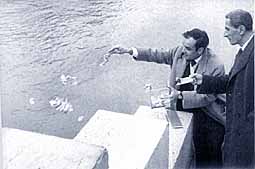
YvesKlein (1962). Transfer of a Zone of Immaterial Pictorial Sensibility to Dino Buzzati, Paris, 26 Jan 1962. http://www.yveskleinarchives.org/works/works18_us.html Image available from http://www.atisma.com/spiritart/Immaterial%20Pictorial%20Sensitivity%20Zone.jpg
The French artist Yves Klein (1928-1962) highlighted both the material and the spiritual nature of exchange (Klein was influenced by Zen Buddhism, Rosicrucianism and alchemy (Seymour 1987)). In 1962, Klein offered to sell a 'zone of immaterial pictorial sensitivity' in exchange for gold leaf. The purchaser bought the gold leaf and Klein provided a certificate in return which was only valid upon being burnt. Klein threw 20g of gold leaf into the River Seine, while the purchaser burnt his certificate. All remains of the transaction were destroyed (Goldberg 1988, p.147). However this is not entirely true. What remains of course is the record of the work in words and photographs. (What is also sometimes overlooked, I recall - though I cannot locate the reference, is that Klein made a profit from the purchase of the gold leaf).
'Great beauty is only a reality when it contains, intelligently mixed with it, "genuine bad taste," "irritating and intentional artificiality," with just a touch of dishonesty.'
Yves Klein (cited in Seymour 1987, p.25)
Bibliography
Designboom. (2011). Money design and history. [Internet]. Available from: http://www.designboom.com/weblog/cat/8/view/5440/money-design-and-history.html (Accessed 20 February 2011)
Goldberg, R. (1988). Performance art: from Futurism to the present. London: Thames and Hudson
Marx, K. (1999). A contribution to the critique of political economy. Marxists.org First Published 1859. http://marxists.org/archive/marx/works/download/Marx_Contribution_to_the_Critique_of_Political_Economy.pdf (Accessed 20 February 2011)
Money Man (1992). Directed by Philip Haas. TV documentary. 60 mins
Seymour A. (1987). Transformation and prophecy. In: Beuys, Klein, Rothko: Transformation and Prophecy. London: Anthony d'Offay Gallery. Pp. 9-28
Topangacreek (2010). J. S. G. Boggs - The art of making money. [Video online]. Available from: http://www.youtube.com/watch?v=gEtKSqzpj0Q (Accessed 20 February 2011)
Warhol, A. (2007). The philosophy of Andy Warhol (from A to B and back again). London: Penguin
Yves Klein Archives. (2011). Zones of immaterial sensibility. [Internet] Available from: http://www.yveskleinarchives.org/works/works18_fr.html (Accessed 20 February 2011)
19/12/2010
"Publication is the creation of a Public"
Matthew Stadler, founder of Publication Studio, based in Portland, Oregon. The studio prints and binds books on demand but moreover is "a laboratory for publication in its fullest sense — not just the production of books, but the production of a public. This public, which is more than a market, is created through deliberate acts: the circulation of texts; discussions and gatherings in physical space; and the maintenance of a digital commons. Together these construct a space of conversation, a public space, which beckons a public into being."
04/12/2010
On style
‘...practically all metaphors for style amount to placing matter on the inside, style on the outside. It would be more to the point to reverse the metaphor. The matter, the subject, is on the outside; the style is on the inside’
Susan Sontag, 1987, 17
It is tempting to think of style as something akin to putting on a coat. But Susan Sontag's words help us look deeper into the nature of style.

Perhaps it is helpful to consider this image of the nave of Lincoln Cathedral constructed in the 13th century in the Gothic style. One can see decoration, to be sure (and the surfaces would have been painted originally). But, it is difficult to see style in this context as in any way superficial. It seems to reside in the very bones of the building.
Bibliography
Sontag, Susan. (1987) On style In: Sontag S. Against interpretation. London: Andre Deutsch. Pp25-36
19/11/2010
Iso Type of Thing
A trailer for the new film on the US' public education system, Waiting for Superman, from Buck. Note the interplay of narration, type, image, motion. The language's info–graphic heritage in Otto Neurath's Isotype, imaged by Gerd Arntz.
16/11/2010
Embedded Messages

An excellent trip last week, to the Pitt Rivers Museum and theOxford University Museum of Natural History. Neighbouring but entirely separate entities, with contrasting taxonomies. Apparently, originally, there was an intent to demonstrate a social Darwinism in the Pitt Rivers, by juxtaposing objects of common function from 'primitive' and 'advanced' cultures. The net effect is opposite, with beautiful examples of the symbiosis of available materials and requisite making. I always return to the cabinets containing object–systems for writing and counting.

These West African Oroko and other symbolic systems, communicate personal insults, calls to battle, requests for foodstuffs, news of death, bids for friendship. The number and orientation of cowrie shells denotes an array of meanings, as described here. The intrinsic character of a cowrie is human and therefore connotes a human situation. Where they face away from one another they really are facing away. Elsewhere, knotted string gives the intuitive property of distance and space to travel.

I reflected afterwards (in the light of messages and matter) on another trip, back in September and in Berlin. The Museum of Otto Weidt's Workshop for the Blind is the original site, where around thirty blind and deaf Jews were employed—and therefore shielded from internment—by Weidt to make brushes and brooms in the early 1940s. Under constant threat, they hid within concealed spaces in the workshop and Weidt obtained false identities (as above, for Marianne Bernstein) and bribed Gestapo officials; any means to stave off the inevitable.

The museum has humility, weighted only by the original nature of the spaces and the stories of individuals who, in the majority were killed and the exceptions who survived. This is the recto and verso of a postcard, thrown from an Auschwitz–bound transportation train by Alice Licht and addressed to Otto Weidt in the remote hope of it finding him, which it did. Somebody picked it up and sent it on.

Alice parents were killed in Auschwitz. She was later transported to Groß–Rosen. Weidt managed to make contact and organised a safe hiding place in Berlin, to which she fled during an evacuation in 1945. She emerged few weeks later, surviving the war and then emigrating to the US. She died in 1987.

This poem, Zurück–Glück (Return–Happiness), written after her escape in April 1945.

Beyond the stories, the walls within the hidden spaces.

Walter Benjamin: "To articulate the past historically does not mean to recognize it ‘the way it really was’ (Ranke). It means to seize hold of a memory as it flashes up at a moment of danger".

A certain resonance in straightforward effects and documentation, telling a human tale. Perhaps the gap to think. The frankness of a factual item. Christian Boltanski has referenced and used as a raw material, the emotional impact of piles of clothes belonging to those deported, discovered in the Nazis' storage warehouses. The specificity of belongings, indicating an individual's life, over the anonymity of a naked body. This piece, Inventaire des Objets Ayant Appartenu a une Femme de Bois-Colombes (1974), from a series of five (I think) bookworks which fully documented the belongings of a woman living in a suburb of Paris.


At no stage do we see an image, a likeness of the woman. Only her taste in books. Which tells a greater truth?

Back to the Pitt Rivers and some more from the Writing & Counting cabinet.


Nearby, a cabinet displaying scrimshaw and other notchmaking, markmaking in bone. An object behaving as a page.
10/10/2010
Visions of cities– the multisensory city

Umberto Boccioni's (1911) 'Futurist' painting, The Noise of the Street Penetrates the House attempts to reproduce the multisensory experience of the modern city, with its noise and endless movement, within the frame of a two-dimensional work, with a fracturing of the traditional Renaissance fixed-point perspective. (The way in which this is also a painting about 'a view' somehow reinforces the point that perspectival representation is inadequate for conveying this multisensory experience).
Literature is a medium well capable of conveying this multisensory experience of the city.
See how Charles Dickens achieves this in this excerpt from Great Expectations (first published 1860-1), Pp 163-4, describing Pip's experience of the City of London:
'When I told the clerk that I would tke a turn in the air while I waited, he advised me to go round the corner and I should come into Smithfield. So, I came into Smithfield; and the shameful place, being all asmear with filth and fat and blood and foam, seemed to stick to me. So, I rubbed it off with all possible speed by turning into a street where I saw the great black dome of Saint Paul's bulging at me from behind a grim stone building which a bystander said was Newgate Prison. Following the wall of the jail, I found the roadway covered with straw to deaden the noise of passing vehicles; and from this, and from the quantity of people standing about, smelling strongly of spirits and beer, I inferred that the trials were on.'

Literature is a medium well capable of conveying this multisensory experience of the city.
See how Charles Dickens achieves this in this excerpt from Great Expectations (first published 1860-1), Pp 163-4, describing Pip's experience of the City of London:
'When I told the clerk that I would tke a turn in the air while I waited, he advised me to go round the corner and I should come into Smithfield. So, I came into Smithfield; and the shameful place, being all asmear with filth and fat and blood and foam, seemed to stick to me. So, I rubbed it off with all possible speed by turning into a street where I saw the great black dome of Saint Paul's bulging at me from behind a grim stone building which a bystander said was Newgate Prison. Following the wall of the jail, I found the roadway covered with straw to deaden the noise of passing vehicles; and from this, and from the quantity of people standing about, smelling strongly of spirits and beer, I inferred that the trials were on.'
An earlier example, from the Romantic era, is to be found in William Blake's poem 'London' (Songs of innocence and of experience, 1794), which, as in Dickens, includes appeals to the ear and touch as well as the eye, along with an embodied feeling of walking in the City.

I wander through each chartered street,
Near where the chartered Thames does flow,
And mark in every face I meet,
Marks of weakness,
marks of woe.
In every cry of every man,
In every infant's cry of fear,
In every voice, in every ban,
The mind-forged manacles I hear:
How the chimney-sweeper's cry
Every blackening church appals,
And the hapless soldier's sigh
Runs in blood down palace-walls.
But most, through midnight streets I hear
How the youthful harlot's curse
Blasts the new-born infant's tear,
And blights with plagues
the marriage-hearse.
Near where the chartered Thames does flow,
And mark in every face I meet,
Marks of weakness,
marks of woe.
In every cry of every man,
In every infant's cry of fear,
In every voice, in every ban,
The mind-forged manacles I hear:
How the chimney-sweeper's cry
Every blackening church appals,
And the hapless soldier's sigh
Runs in blood down palace-walls.
But most, through midnight streets I hear
How the youthful harlot's curse
Blasts the new-born infant's tear,
And blights with plagues
the marriage-hearse.
01/06/2010


15/04/2010
The Great And Powerful's Letterhead

This is MGM's letterhead from 1939, promoting what is amongoneofmanyofour favourite films, The Wizard of Oz (via A Rook's Foundry). Very nice and odd hand rendered, nib-pen type, something we discussed in pre-term-end Macmillan Children's Book sessions.

An echo of Peter Blegvad's renderings for the English language imprint of Tove Jansson's 1952 The Book About Moomin, Mymble And Little My (via), translated by Sophie Hannah in 2001. Some control of the colour, inflection and pictorial within the type so it doesn't tread on the toes of the imagery.
Subscribe to:
Posts (Atom)