Showing posts with label Character. Show all posts

18/11/2013

Casting Kurtz

Note: essential that you, individually, move through and beyond these direct and indirect 'castings' of Mr. Kurtz – particularly Kinski and Brando. The idea here is to make plain a method one might apply, in order to see and hear him.


Leonardo da Vinci: Study of the effect of light on a profile head (c. 1487–1490).


Charles Manson. "From the beginning of his notoriety, a pop culture arose around him in which he ultimately became an emblem of insanity, violence and the macabre" (via).


Pablo Picasso: Self portrait (1972).


Footage of Klaus Kinski, during filming of Werner Herzog's "Nosferatu the Vampyre" (1979), a melancholic, lyrical homage to the magnificent "Nosferatu, eine Symphonie des Grauens" (1922), directed by F.W.Murnau.

In both versions, a kind of infamy has grown around the relationship between director and lead actor – where the actor and the part also merge. In the case of Murnau's original, Max Shreck is so synonymous with his portrayal of the verminous Count Orlock, that the recent film "Shadow of the Vampire" (2000) suggests — with unsettling humour — that the actor was (indeed) Undead.

Herzog and Kinski's volatile collaboration led to five seminal films, all of which cast Kinski somehow within a Kurtz-like hegemony. Herzog's documentary "My Best Fiend" (1999) is the definitive account. 


Portrait bust of a man, 1st century B.C.; Republican Roman – from the Metropolitan Museum of Art, New York. "Prestige came as a result of age, experience, and competition among equals within the established political system. These are the values expressed in portraits of grim-faced, middle-aged men, such as the one featured here."


Eduardo Paolozzi: "Kardinal Syn" (1984) (via Tate).


Marlon Brando as Colonel Kurtz, in Francis Ford Copolla's "Apocalypse Now" (1979). Here, reading from T.S. Eliot's "The Hollow Men" (1925). The poem begins with an epigram, quoting "Heart of Darkness". Later, it references Dante Alighieri's "Inferno" from "The Divine Comedy" (c. 1308–1321), as does Conrad throughout the novella.

"The Hollow Men" resonates with "Heart of Darkness" throughout. For example:

This is the dead land
This is cactus land
Here the stone images
Are raised, here they receive
The supplication of a dead man's hand


Under the twinkle of a fading star.
Is it like this
In death's other kingdom
Waking alone
At the hour when we are
Trembling with tenderness
Lips that would kiss
Form prayers to broken stone.

25/05/2011

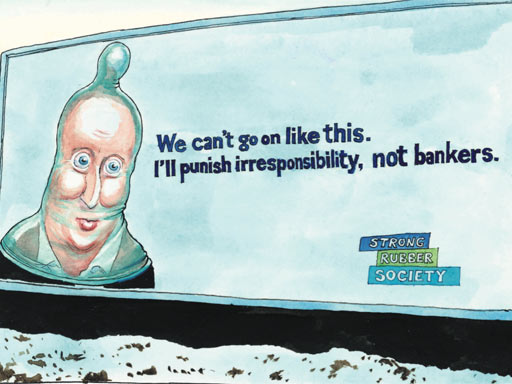
Steve Bell at the Cartoon Museum


Source: http://static.guim.co.uk/sys-images/Guardian/Pix/pictures/2010/1/12/1263261460869/steve1.jpg


Political cartoonist Steve Bell has an exhibition at the Cartoon Museum, until July 24th. Bell also charts his career and discusses his approach to caricature in a Guardian story that accompanies the current exhibition.


Bell Epoque: 30 Years of Steve Bell is at the Cartoon Museum, 35 Little Russell Street, London WC1, until 24 July. Students £3 with ID.

09/01/2010

Sendak on Illustration / Extruded Characters


Maurice Sendak, on what it is (to him), to illustrate a book. He talks about the illustrator quietly wishing to have written, with imagemaking the next best thing to do. Feels as if a similar place-in-the-food-chain logic has been used as basis for criticism of the just-released 'Where The Wild Things Are', directed by Spike Jonze. Will go see but expect that Spike has just tried to do something else.


The book of course is one of the greats, with less than 200 words and it's wonderful left-to-right kinetic. A 101-minute film of the three-dimensional world is a different object. The book is so much about the drawing, the hairyness and claustrophobia emerging from hairy, claustrophobic linework.


So illustrators have a crisis about their pictures spoiling a book for the mind's eye. Here it seems is an equivalent, of a filmmaker extruding a two-dimensional classic. It looks as if the collaboration with Jim Henson's Creature Workshop gives the cinematic monsters their own breathing space, with a Big Bird inflection.


It is a strange and counter-aesthetic compulsion to make something that innately belongs to a world of flatness and line, literally live-action and three-dimensional. A clear example was Robin William's incarnation of Popeye. Here is E.C. Segar's Thimble Theatre original, c. 1930, with the archetypal, everything-facing-the-front face.


And here is the 'live' but dead version. Same for Carreyfication of Dr. Seuss. Leave well alone. It worked already.

20/01/2009

Innate Creepiness of Stop-Motion


Excerpt from The Mascot by Ladislas Starewicz (1933). See the full animation, the array of characters and a full scope of the live action and stop-motion at the very useful Fantastic Animation.

19/01/2009

Ubu, Miró, Commedia dell'Arte, Schlemmer


Alfred Jarry Ubu Roi (1888). Theatre of the Absurd.
"The central character is notorious for his infantile engagement with his world," wrote Jane Taylor. "Ubu inhabits a domain of greedy self-gratification." Jarry's metaphor for the modern man, he is an antihero- fat, ugly, vulgar, gluttonous, grandiose, dishonest, stupid, jejune, voracious, cruel, cowardly and evil."


See Jan Lenica's animation


Wookmark's trefoil knot.


Joan Miró's lithograph, Ubu Roi aux Baleares (c.1966)


Eric Campbell in The Count (1916) (via BFI).


Commedia dell'Arte (c.C16th) Pantalone


Jabba: over-rendered, over-realised but interesting character.


Blob Sculpin (via Things That Are Wrong).


Oskar Schlemmer's Das Triadische Ballett (1916-1932) (via Flickr).


Oskar Schlemmer's Das Triadische Ballett (1916-1932).


(via Mart)


15/01/2009

Head Net


Net for a character head (from a French children's publication?) as seen on the wonderful An Ambitious Project Collapsing.

14/01/2009

The Goblin Spider


An exquisite, one-eyed goblin character from The Goblin Spider, a Japanese fairy tale of 1899, printed from woodblock with characteristic colour gradient backgrounds. The translated version by Lafcadio Hearn. See the complete book at the New York Public Library's site.

13/01/2009

Rogues' Gallery


Dick Tracy characters Pruneface and Flattop Sr., Chester Gould, 1943-44, Tribune Media Services (via LA Times). Note the hardboiled-economy of the character names. And that the appearance always had seemed to have catalyst, an past disfiguring event.

12/01/2009

Nez


Alberto Giacometti's Nose (1947) (via Peter Foerger).


Beautiful Monsieur Gainsbourg with Jane Birkin.


The elastic John Barrymore as Mr. Hyde (1920). Witness the wonderful, terrifying, pantomime-absurd, angular change.


Blinky Palermo's Schwarzes Quadrat und Grünes Dreieck (1970) (via Artnet).


Margaret Hamilton as The Wicked Witch of the West alongside a terrifying Judy Garland as Dorothy (1939).

Chelsea Smile


The great Conrad Veidt (he of The Cabinet of Dr. Caligari) as Gwynplaine in The Man Who Laughs (1928), whose 'permanent rictus grin' is given him as a child by a surgeon, ordered by King James II to punish an offence caused by his nobleman father.


The film is fundamentally a melodrama (with the protagonist as a tragic hero) but has come to be seen as a horror classic. The story is based on Victor Hugo's tale of craving and desire, L'Homme Qui Rit (1869). This, in turn, was Bob Kane's inspiration, of course, for The Joker.


With reference to the project and London folklore, mutilation of this type has a root in the 'Chelsea Smile'. Inflicted, according to lore by Chelsea football fans, it somehow is a story that holds its place alongside Spring Heeled Jack and other 'bogeyman' tales in the way it taps undilute fear. This is C'est Moi Ce Soir's Ms. Clinton in the act (via Soma Gallery).