
They're even getting to be like money to me now.'


JSG Boggs (1997). Available at http://www.designboom.com/weblog/cat/8/view/5440/money-design-and-history.html
Our discussion at Thursday's seminar on 'Shopping' reminded me of the artist JSG Boggs. He produces (by meticulous drawing and printing) dollar bills of various denominations, as works of art, which he then attempts to 'spend' in real transactions in real shops or restaurants - and for the value declared on his 'money'. As one might imagine this causes some perplexity to cashiers and shopowners. To further confuse matters he also requests a receipt and the correct change as a result of the transaction.
See here a Youtube clip (Topangacreek, 2010) from the wonderful (and hilarious) TV documentary Money Man (1992), which shows such a transaction taking place - in which Boggs profers one of his own $50 bills and also asks for a receipt and change from the $7.20 purchase: http://www.youtube.com/watch?v=gEtKSqzpj0Q .
Following his transaction Boggs will then offer to buy back the dollar bill (negotiating on the price), which he attaches with information on provenance and the till receipt and offers for sale to the art market. The shopkeeper makes a handsome profit and he makes a further profit. Often people choose to retain the Boggs work or sell it on themselves.
Boggs deliciously subverts the nature of the transaction - confusing the exchange of money for commodity, by producing his own 'money' - which as a work of art is not really money but another commodity itself. To use Marx's terms, Boggs 'money' is a commodity with both use value and exchange value - and not necessarily the exchange value declared on his note.
The issuing of paper money, what Marx terms 'money of account' (as opposed to gold with its intrinsic value as a commodity) is of course very carefully controlled and regulated by the state (Marx, 1999). Boggs' issuing of his own 'money' - or 'art' according to Boggs - appears to threaten the state's control over the issuing of money, and he has had a number of run-ins with the US authorities over this (Money Man, 1992). Through art he pulls apart and exposes hidden aspects of economy, of which we are not normally conscious in our day to day lives.
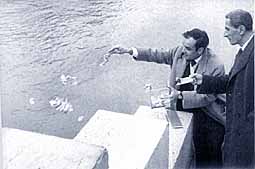
YvesKlein (1962). Transfer of a Zone of Immaterial Pictorial Sensibility to Dino Buzzati, Paris, 26 Jan 1962. http://www.yveskleinarchives.org/works/works18_us.html Image available from http://www.atisma.com/spiritart/Immaterial%20Pictorial%20Sensitivity%20Zone.jpg
The French artist Yves Klein (1928-1962) highlighted both the material and the spiritual nature of exchange (Klein was influenced by Zen Buddhism, Rosicrucianism and alchemy (Seymour 1987)). In 1962, Klein offered to sell a 'zone of immaterial pictorial sensitivity' in exchange for gold leaf. The purchaser bought the gold leaf and Klein provided a certificate in return which was only valid upon being burnt. Klein threw 20g of gold leaf into the River Seine, while the purchaser burnt his certificate. All remains of the transaction were destroyed (Goldberg 1988, p.147). However this is not entirely true. What remains of course is the record of the work in words and photographs. (What is also sometimes overlooked, I recall - though I cannot locate the reference, is that Klein made a profit from the purchase of the gold leaf).
Bibliography
Designboom. (2011). Money design and history. [Internet]. Available from: http://www.designboom.com/weblog/cat/8/view/5440/money-design-and-history.html (Accessed 20 February 2011)
Goldberg, R. (1988). Performance art: from Futurism to the present. London: Thames and Hudson
Marx, K. (1999). A contribution to the critique of political economy. Marxists.org First Published 1859. http://marxists.org/archive/marx/works/download/Marx_Contribution_to_the_Critique_of_Political_Economy.pdf (Accessed 20 February 2011)
Money Man (1992). Directed by Philip Haas. TV documentary. 60 mins
Seymour A. (1987). Transformation and prophecy. In: Beuys, Klein, Rothko: Transformation and Prophecy. London: Anthony d'Offay Gallery. Pp. 9-28
Topangacreek (2010). J. S. G. Boggs - The art of making money. [Video online]. Available from: http://www.youtube.com/watch?v=gEtKSqzpj0Q (Accessed 20 February 2011)
Warhol, A. (2007). The philosophy of Andy Warhol (from A to B and back again). London: Penguin
Yves Klein Archives. (2011). Zones of immaterial sensibility. [Internet] Available from: http://www.yveskleinarchives.org/works/works18_fr.html (Accessed 20 February 2011)


