Showing posts with label Lecture One. Show all posts

03/05/2013

Clapping music


In this piece, Reich uses the most fundamental of human attributions, beside the voice, to "create a piece of music that needed no instruments beyond the human body". This piece of work, while developed from an intrinsic knowledge of music, is also based on rules, and therefore, patterns. I was struck when revisiting this piece recently, that one could liken this piece to wave interference patterns; those moments where the patterns of the rhythm fall in and out of sequence with each other constructive and destructively, adding to the rhythm, creating moments of quiet.
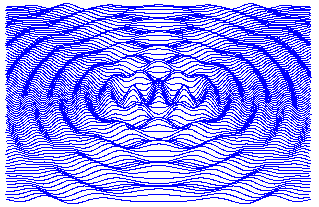


"...one performer claps a basic rhythm, a variation of the fundamental African bell pattern in 12/8 time, for the entirety of the piece. The other claps the same pattern, but after every 8 or 12 bars s/he shifts by one eighth note to the right. The two performers continue this until the second performer has shifted 12 eighth notes and is hence playing the pattern in unison with the first performer again (as at the beginning), some 144 bars later."


See also: A juggling interpretation and György Ligeti's Poème Symphonique For 100 Metronomes.


– Rosie

01/05/2013

The face on mars


The original image taken by the Viking 1 orbiter in 1976.


Humans have always projected their own hopes and fears onto interstaller objects like this famous cultural anthropomorphism. As a social species we are particularly hard-wired to recognise faces. Perhaps this is the reason why Jesus pops up on a piece of toast, or a giant face emerges out from the shadows of arbitrarily arranged Mars rocks.


ESA/DLR/FU Berlin (G. Neukum), MOC (Malin Space Science Systems)(2006)


NASA used the likeness to their advantage, as a way to garner interest in Mars. They even suggested themselves in the 1976 press release: "The picture shows eroded mesa-like landforms. The huge rock formation in the center, which resembles a human head, is formed by shadows giving the illusion of eyes, nose and mouth."  When NASA returned to Mars in 1997, they felt they owed it to the taxpayer and reshot this famous image. With better quality equipment, the mystery disappears. No human head, no alien monument. Just a natural landform. 

Read more about unmasking the face on Mars.

– Natalie

30/04/2013

Making sand swim

Klaus Weber Sand Fountain (2012)


Klaus Weber's piece Sand Fountain is both transformative and oppositional – encouraging a reconsideration (among other things) of what a fluid is, even if water is wet and sand is dry – if one can be substituted by the other then what exactly is the difference?
The falsification criteria that Malte spoke about is also concerned with being oppositional, exploring where our theories and ideas about the world break down and where they hold their own. 


– Jennifer

29/04/2013

Science fiction: Asking questions to the future


Latest since the industrial revolution, the cultural significance of science has become impossible to miss. It has transformed our lives beyond recognition and is continuing to do so at an ever increasing speed. The technologies we create change the way we interact with the world. Through the internet we have created means of communication that are dissolving our traditional notions of time and information. Before we have even come close to understanding its significance for the coming generation, this piece of technology itself has already transformed again and is now delocalised and touchable on a smart phone. How will this development change our view of the world? Will we be able to keep up with our own progress? Through science and technology, we have not only achieved a greater understanding of the world around us, we have also become able to shape it. But what happens when we do it?


Science fiction often attempts to trace out the answers without us even asking. Which way will tomorrow’s technology pave for us? What role will it play in the future of our society? As complex and speculative as these questions are, we cannot hide from them. In many science fiction stories this becomes most strikingly obvious when artificial intelligence enters the stage. We may be able to avoid asking ourselves the question what we want to do with our technology. But should we ever build an intelligent machine, it will do it for us. From ‘Odyssey 2001’ to ‘Blade Runner’ and Isaac Asimov’s short stories, once the future itself asks us how we got there, we better come up with a good answer.


– Malte

Signs of the Fourth Dimension


In this lecture author and professor at the University of Texas, Dr. Linda Dalrymple Henderson, discusses the subject of her book 'The Fourth Dimension and Non-Euclidian Geometry', pictured below. In it, she traces a parallel development between developments in geometry and modern art.


Non-euclidian geometry required a shift in how we perceive and understand the space we live in, from assumptions based on immediate perception and human experience to concepts which are no longer derived from human experience and intuition. You can draw two parallel lines on a piece of paper and they will never meet, but draw those two lines across the surface of the spherical Earth and they will curve and meet. Henderson argues that this development, with the possibility of a spatial fourth dimension "encouraged radical innovation by a variety of early twentieth-century artists, ranging from French Cubists, Italian Futurists, and Marcel Duchamp, to Max Weber, Kazimir Malevich, and the artists of De Stijl and Surrealism."


More on Non-Euclidean Geometry: 


17/04/2013

Invisible Structures


"Visualization is not simply a mediation between an independent world and a human perceiver. An image does not stand between the thing itself and a knowing subject. The selection of specimen, sites, the re-ordering of fields into grids, the operations of tagging, encoding, and marking, these activities reach into the world, arrange it in a pose, and cultivate its accountability. These artifices do not necessarily negate the world's natural accountability, although in some cases they are blamed for distortions and illusions. Instead, they are the very means through which natural order is revealed, ordered, compared, encoded, and quantified. Consequently, in answer to the question of what studies of visualization are about, we can say that they are about the production of scientific reality."

Michael Lynch, "Visual Cultures of Science" (2006)


– Malte 

Jiggling Atoms


Every project we do seems to start with Richard Feynman, and this series, called Fun to Imagine, is where we also derived our name. Feynman was not just a wonderful teacher, but was also a tremendously gifted theoretical physicist; he worked on the atomic bomb, got the Nobel prize in 1965 and also played the bongos (amongst other things). But of course, most importantly for us, it's his incredible gift for explaining physics to non-scientists. All from the seat of his armchair, watch how he reveals with such wonderful poetry and insight about "the unbelievable nature of nature".