Showing posts with label sound. Show all posts

03/05/2013

Clapping music


In this piece, Reich uses the most fundamental of human attributions, beside the voice, to "create a piece of music that needed no instruments beyond the human body". This piece of work, while developed from an intrinsic knowledge of music, is also based on rules, and therefore, patterns. I was struck when revisiting this piece recently, that one could liken this piece to wave interference patterns; those moments where the patterns of the rhythm fall in and out of sequence with each other constructive and destructively, adding to the rhythm, creating moments of quiet.
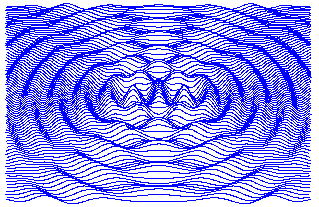


"...one performer claps a basic rhythm, a variation of the fundamental African bell pattern in 12/8 time, for the entirety of the piece. The other claps the same pattern, but after every 8 or 12 bars s/he shifts by one eighth note to the right. The two performers continue this until the second performer has shifted 12 eighth notes and is hence playing the pattern in unison with the first performer again (as at the beginning), some 144 bars later."


See also: A juggling interpretation and György Ligeti's Poème Symphonique For 100 Metronomes.


– Rosie

02/05/2013

Resources from Lecture 3: Electricity

Educational films explaining the physical principles behind sound waves, their generation and manipulation:


The Nature of Sound (1948)


Sound Waves and Their Sources (1933)


An overview of concepts in electricity, covering topics such as electric charge, current and conductivity, electric and magnetic force:


Principles of electricity (1945)


An educational film showing the creation of magnetic fields through electrical current:


Electromagnets (1966)


An educational film covering phenomena such as reflection and refraction of light, focussing and the principles of cameras:


The Nature of Light (1948)


A historical overview of color and the associated physical principles of light. The film is split in six parts:


Light and Color


A public lecture by Richard Feynman explaining the wave-particle duality and its role in quantum mechanics:


Richard Feynman: Probability and Uncertainty – The Quantum Mechanical View of Nature (1964)