


17/04/2012


20/01/2012
Luke on crane.tv
Crane.tv paid Luke a studio visit recently. Interesting thoughts on his working roots and balance. And a little tribute to all of you towards the end.
03/01/2012
David Hockney's Bigger Picture
David Hockney interview from Royal Academy of Arts on Vimeo.
David Hockney's major new exibition opens at the Royal Academy on January 21st. He is an artist who works within the Renaissance tradition of depiction, with those central concerns of nature, space and time, and, as in this forthcoming show, the tradition of the landscape. But he is also an artist who has embraced new technology; photography, fax, and now the iPad. I have always admired him - his draftsmanship, his thoughtfulness, and even his humour.
Last week (26 Dec 2011) BBC Radio 4 devoted a Start the Week programme to Hockney, discussing his latest work. The in-depth interview by Andrew Marr was both revealing and fascinating. He spoke about drawing, about observation of nature, the benefit and the excitement of seeing consecutive springtimes at the same place over a number of years. It showed the depth of his engagement with his subject.
He had a lot to say about technology, and it is apparent that the use of computer technology has become integrated into his process of picture making, even when the result is painting. David Hockney has always been interested in technology, not for its own sake, but in furthering his picture making.
The camera is one example of his embracing of technology and investigation of picture making. 'Photography is not a final reaching of reality. Technology is opening something up, we are able to alter pictures.' He also noted that 'Cameras give you a certain type of view, but it’s not the human view.'
 |
| David Hockney (1983). Walking In The Zen Garden, Ryoanji Temple, Kyoto
1983 photographic collage, 40 x 62 1/2 in. http://www.hockneypictures.com/photos/photos_collages_06.php |
 |
David Hockney (2011) The arrival of spring in Woldgate, East Yorkshire in 2011
ipad drawing printed on paper 144.4 x 108.3 cm © David Hockney http://wwwimg.bbc.co.uk/programmes/i/512xn/f11b28a2e586a3017ad932e490ddc80eb46f1fc5.jpg |
For me Hockney's approach encapsulates the paradoxical relationship with the world which we can now enjoy (and I do mean enjoy) - he embraces the latest technology whilst, at the same time, acknowledging the importance of craft and of 'the hand'. He cited a Chinese saying: 'In drawing you need the hand, the eye and the heart. Two won’t do!'. And he spoke about the importance of craft in the work of the artist. 'I would say the hand counts, there’s a whole group of other people who say it doesn’t, it’s a little bit insulting to craftsmen isn’t it?' And this aspect of craft has an importance for pedagogy, he maintained:
Food for thought... perhaps, to some extent, one can teach, or at least encourage and facilitate, the poetry (not forgetting of course that there is also a 'craft' to poetry). But Hockney poses here the interesting question of just where that balance lies between the poetry and the craft in the teaching of art.'I used to point out, in an art school, you can teach the craft. It’s the poetry you can’t teach, but now they try and teach the poetry and forget the craft. It’s craft that can be taught.'
He related a story about his Mother coming to his exhibition at which there was a sculptural piece by Barry Flannagan whichcontained a large rope. 'Did he make the rope?' his Mother asked...
Bibliography
Start the week: David Hockney Special (2011). BBC Radio 4. Monday 26 December. 45 minutes. Available at http://www.bbc.co.uk/programmes/b018g2yz (Accessed 4 Jan 2012)
Royal Academy of Arts (2011). David Hockney RA: a bigger picture. Interview. Royal Academy of Arts Video online. http://www.royalacademy.org.uk/exhibitions/hockney/ (Accessed 4 Jan 2012)
Links & information
- You can listen to the BBC interview with David Hockney at http://www.bbc.co.uk/programmes/b018g2yz
- David Hockney RA: A Bigger Picture can be seen at the Royal Academy from 21 January to 9 April 2012. Advance booking is recommended. http://www.royalacademy.org.uk/exhibitions/hockney/
- http://www.hockneypictures.com/home.php
- See also Peter Nencini's reflections on the handmade and the digital in this earlier post on Camberwell Illustration
Wroe, N (2012) David Hockney: a life in art. The Guardian (Review), Jan 14, <Available online at> http://www.guardian.co.uk/culture/2012/jan/13/david-hockney-life-in-art (Accessed 14 Jan 2012)
30/11/2011
Postmodernism
We look at the present through a rear-view mirror.It is difficult, as Marshall McLuhan observed, to understand the times we are living in. And perhaps it is only now that we have some chance of really understanding, in retrospect, the phenomenon that became known as ‘Postmodernism.’
We march backwards into the future.
(McLuhan and Fiore 1996: 75)
The exhibition Postmodernism: style and subversion. 1970-1990
(Victoria and Albert Museum, to 15 January 2012), attempts to lend some coherence to the subject of postmodernism, by presenting a broad survey of design and art from these two decades (and a little before). In this it is broadly successful, and the curators, Glenn Adamson and Jane Pavitt, deserve credit, I believe for a largely coherent treatment of postmodernism through selection and exhibition of a wide range of works from architecture, art and design.
The exhibition does of course have some of the disadvantages of a survey, a widely cast net and consequent lack of depth in any one discipline, along with a sense of works being highly filtered and selected, which a focus on a more narrow field could have avoided. But it also has the merits of a survey – a broad and inclusive treatment, and a certain didactic clarity. And there is still a focus, appropriate to the V&A, which is, of course, design.
There are, as the curators explain in the catalogue essay, exceptions – notably for me, the literary, since one might argue that postmodernism sprang at least as much from literature as from architecture.
There is also an odd paradox, the careful arrangement of the exhibition, more or less, into disciplines – e.g. architecture, graphic design, furniture (though with thematic connections that also cross the disciplines). And a greater paradox of the seeming use of chronology – a paradox because the synchronic, and a notion of the ‘end of history’ (Fukuyama) was a feature of the postmodern. History is back now. And probably modernism too – architecture has long spoken of the ‘neo-modern’ and Bourriaud has coined the term ‘Alter-modern’ for our present times. Perhaps the modern never really went away – except that today’s modernism can not be like that of the 1960s...

Ettore Sottsass (1969). Teapot
Ettore Sottsass’s (1972) Basilico Teapot Prototype, in painted wood, encountered in the first room of the exhibition, seemed to set the tone well (the above image is an earlier version). A playful application of architectural form to a domestic object – light hearted and yet, oddly alien. Ironic, and quoting history with little sense of any weight of that history – a basilica turned teapot.

Venturi R (1964) Vanna Venturi House
Robert Venturi’s (1959-1964) Model of Vanna Venturi House also gave insight into the origins of the postmodern. Not far off the modern at all, and yet, it had subverted the archetypal house by absurd shifts of scale and distortions of conventional form. And a slightly surprising arc, decorating the facade, interrupted the otherwise linear forms – the arc itself broken by a jarring interruption of the facade that penetrated the interior space. (Venturi’s book Learning from Las Vagas is very illuminating about postmodern architecture).
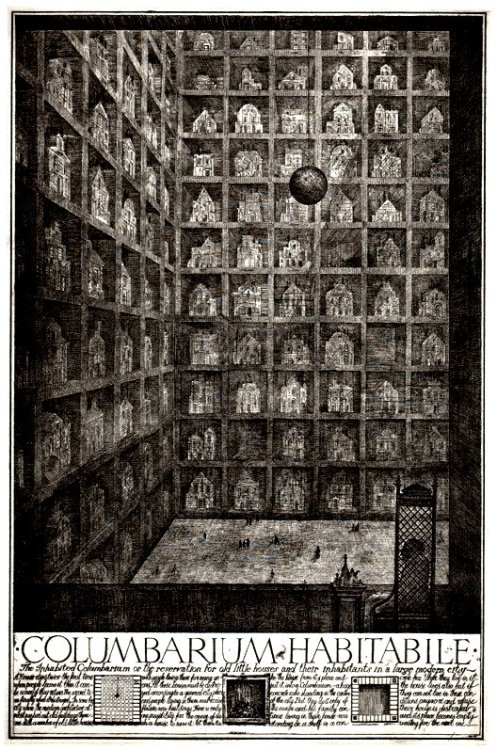
Brodsky and Utkin (1989) Columbarium Habitabile. Etching http://25.media.tumblr.com/tumblr_ksqvya72to1qzz5i6o1_500.jpg
Other pieces that caught my eye included Paolini’s Arte Povera work L’altra figura (1984) and the fantasy architecture of Alexander Brodsky and Ilya Utkin with their Soviet era etching Columbarium habitabile (1989) – a ‘reservation for old houses and their inhabitants in a large modern city.’
Aside from seeing new works (and the show had an exciting global scope) I was struck by a number of themes. Firstly the impact of architecture – that often escaped architecture itself – (Pieter de Bruyne’s (1975) Chantilly Chest, and other furniture and domestic objects had strongly architectural feel). A second theme that came over well was bricolage – the idea of working with ‘oddments left over from human endeavours’ (Levi Strauss - exhibition notes). And, thirdly, a comment by my colleague Mary Kuper, who noted that postmodernism seemed to be marked by an almost complete separation of form and function (in contrast of course to the marriage of form and function in the modern). This is somehow where the question of style comes in. Bricolage – a cobbling together of diverse elements – became an often jarring aesthetic choice in itself. But the separation of form and function, and the eclectic quoting from the past, without worrying too deeply about historic significance, lent itself to a playful approach to style, and the playing on style, seemingly for its own sake, that at times amounted to enthusiastic and guilt-free stylisation. Style is a complex question, and one to which we will return in future...
Bibliography
McLuhan M. & Fiore Q.(1996) The medium is the massage. London: Penguin
Venturi R. (1977). Learning from Las Vegas. Cambridge MA: MIT Press
14/11/2011
Postmortemism
"There are an infinity of ways in which you can move from that spot over there to here. But have you figured out those movements in your head, or are we seeing your soul in motion? Even that fleck at the tip of your nail embodies your soul... the essential thing is that your movements, even when you're standing still, embody your soul at all times."


This 'embodiment' does remind me of the acute, needle-sensibility of Matthias Grünewald's The Crucifixion (1515) (via).

And the artificial limbs at the Wellcome Collection's permanentMedicine Man displays.

The first corner turned in the show featured two long-held-heroes; Ettore Sottsass and Tadanori Yokoo. This poster (via), from 1965. Learning from Las Vegas — as a documentation of the strip, rather than the later book — began in 1968. A group of the earliest works in the show are from this year too. Interesting to think of the student/worker protests as a cultural catalyst for Po-Mo.

Das Scweizer Plakat (1984) by Wolfgang Weingart, via MoMA.

And Kunsthalle Basel Kunstkredit (1976-77), also by Weingart; alsovia. A nice conversation was had, in front of Yokoo's and Weingart's posters. The Weingart characteristic is so much a product of its technical time; the make and then break with the Swiss typography amplified by the dot-screen photosetting of layers. Intrinsically planographic. But also the fragmentation is making evident the gridded alignments it breaks, so it's a respectful eruption.

30/10/2011
Adrien Gary Lucca, colour mixing and separation

Regarding the upcoming project, on reprographic process. "Adrien Gary Lucca is currently researcher at the Jan van Eyck Academie, Maastricht, The Netherlands. He creates large-scale paint drawings which confront mathematics, geometry, forms and colours. For the colour studies, he has developed a personal colour mixing methodology inspired by the 19th-century research of Georges Seurat. The second series of works may seem like grey charts, or scales of brightness. Black paint lines are carefully quantified inside bi-dimensional forms (circles or squares); the contrast between the white colour of the paper and the black paint varies from a minimum to a maximum point. These studies are models for future large-format wall drawings that will interact with the lighting like custom in-situ filters." Quoted from — and via — We Find Wildness.
18/09/2011
Where Blake saw angels - replanting the Angel Oak on Peckham Rye

Adriana, reciting poetry on Peckham Rye (photo: (c) Scott Johnson 2011)
Thanks to Scott Johnson, for this post recounting today's Blake Society event:
In 1765 an eight-year-old William Blake saw his first vision; 'A tree filled with angels, bright angelic wings bespangling every bough like stars.' He saw this on Peckham Rye.
Today I went to the Rye to join the Blake Society and artist John Hartley in the planting of a young oak tree somewhere near that spot where William Blake first saw his angels.The event began at noon with a lady called Adriana who - in eighteenth century costume - recited poetry; mostly about angels; at a string of locations around Peckham Rye Park.
This was followed by a performance and video screening by Matt Sexton. We gathered round an oak tree in the park; and a video played from his laptop which lay on the floor, covered in oak leaves. At the same time, he walked through the crowd with a hand-held projector, projecting the film onto people's bodies.Matt explained afterwards that the video contained interviews of some of the 62 South African school children who in 1995 all witnessed a UFO. He said that the children's vision of the UFO was partly a product of our time as Blake's vision of angels was partly a product of his.

Planting of the Angel Oak (photo (c) Scott Johnson, 2011)
From here we moved to a space on the Rye that is believed to have been close to where William Blake had his vision.Artist John Hartley explained that, as a child, Blake lived in the West End; an area which at the time was the margins of London; and that Peckham today is in some ways an area of margins. He said that artists are attracted to margins and so was William Blake. John then explained that the new sapling had been brought to the Rye from the margins of England. He and a friend had driven to the coast, to an eroding cliff and taken a young oak that was ready to fall into the sea, and brought it there to Peckham Rye. As the tree was lowered into it's new hole, everybody was encouraged to help by chucking a handful of dirt in.
The new Angel Oak can be seen at the Dulwich end of Peckham Rye.
Links:
Audio bite of the event http://soundcloud.com/herebeangels/episode5
John Hartley's web site http://www.ambivalency.net/angel%20oak.htm
The Blake Society http://www.blakesociety.org/2011/08/23/september-event/


